

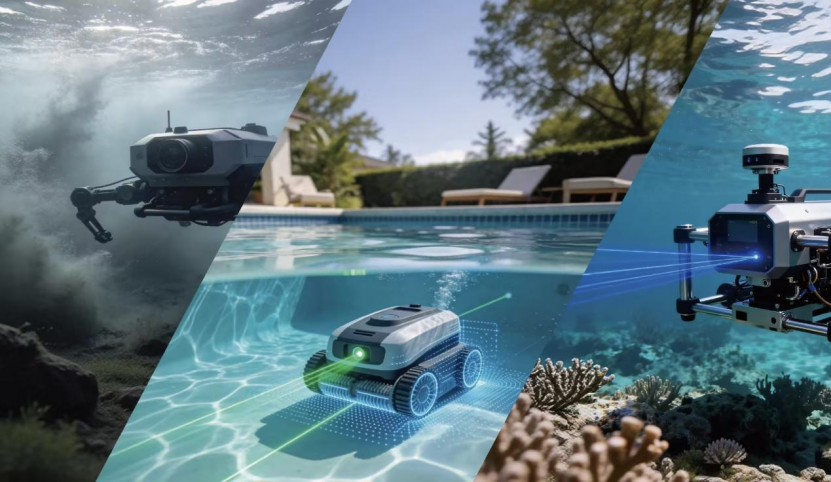
As autonomous mobile technology extends from indoor floors to underwater spaces, pool cleaning robots are becoming an important growth area in the field of intelligent hardware. However, unlike vacuum cleaners and drones, pool robots face a series of unique physical limitations in terms of environmental perception: optical attenuation caused by turbid water, constraints on sensor layout due to sealed structures, limited space and power consumption budget, as well as the rigid requirement for long-distance high-precision measurement.
SPARC Sensor (owned by synexens) has launched the R5000 series single-photon ranging chips based on its self-developed dToF technology. This series of chips, through targeted optical design and underlying architecture optimization, provides a highly reliable and low-cost environmental perception solution for pool cleaning robots.
一. System-level design logic for underwater scenarios
From the very beginning of its design, the R5000 series systematically analyzed the swimming pool cleaning scenario and focused on addressing the following four core engineering challenges.
1. Addressing turbid water quality and optical interference
The common impurities in swimming pool water, such as residual chlorine, algae particles, skin flakes and fallen leaves, pose challenges to the signal quality of the optical ranging system. The attenuation characteristics of different wavelength light sources in water vary, and selecting an appropriate wavelength scheme is the key to improving the perception stability.
The R5000 series supports customers' customization of filter wavelength selection (blue light, green light or infrared light). Under pool operation conditions, blue light and green light exhibit stronger penetration and lower attenuation coefficients compared to infrared light. This design enables the entire machine manufacturer to flexibly configure the optical front end according to the target water quality conditions, thereby enhancing the stability of the echo signal and the effective detection distance at the physical level.
2. Balancing waterproof sealing and optical transmission
Sensor solutions that rely on triangulation or fixed imaging planes have to deal with the effects of refraction and optical path deviation when operating through transparent sealing covers, as their accuracy and consistency need to be maintained.
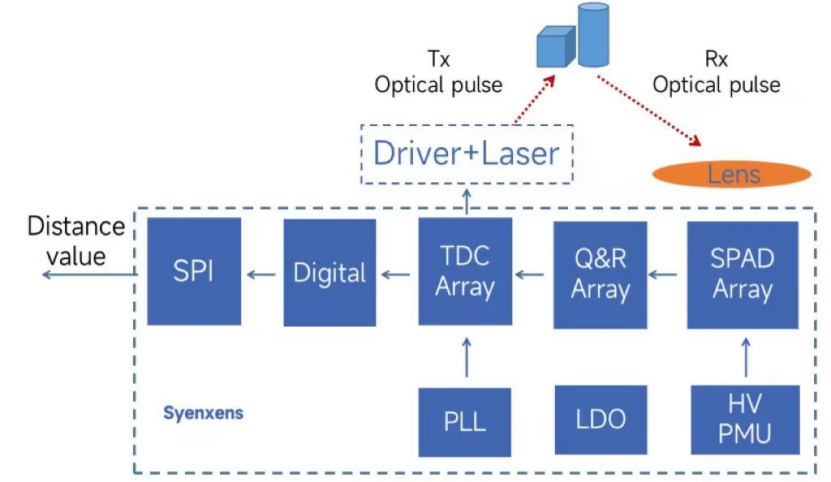
The R5000 series is based on the direct time-of-flight principle and can normally transmit and receive signals through transparent media such as glass and acrylic. The laser is emitted through the observation window, and the reflected light from the target travels along the same path and is received. This ensures the complete sealing protection of the entire machine while maintaining the consistency of the ranging performance.
3. Adaptation to compact structure and low power consumption requirements
The internal space and power consumption budget of consumer-level underwater robots are severely limited.
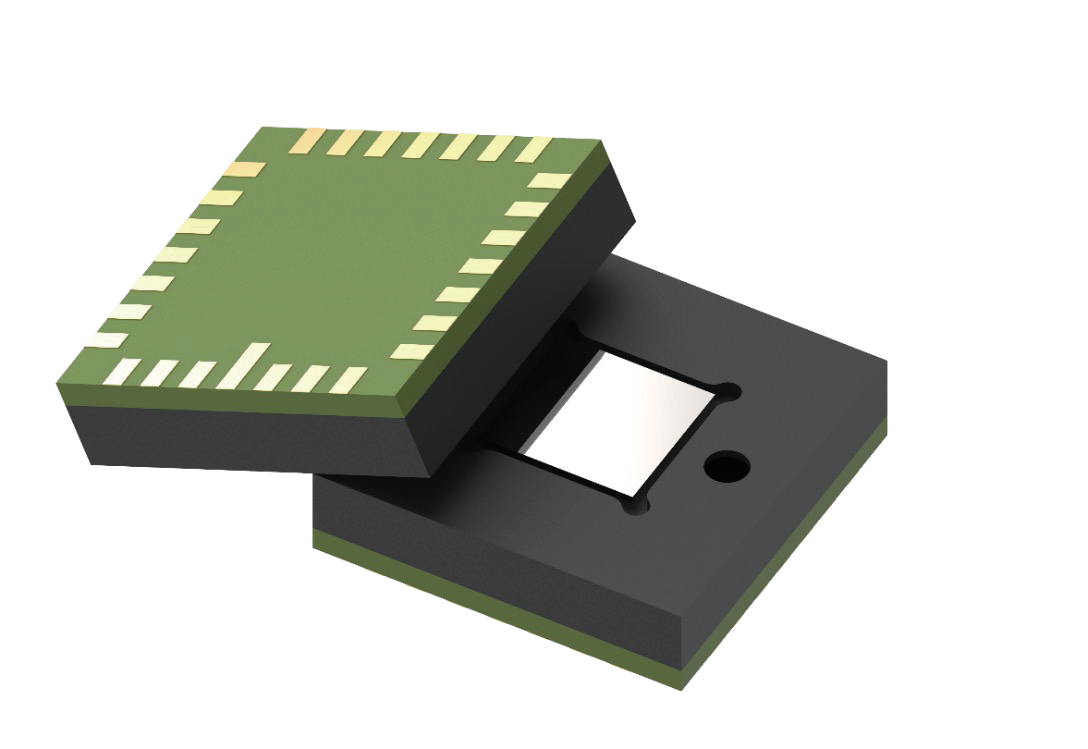
The R5000 series has a package size of 4.5mm × 4.5mm × 1.1mm. It integrates an SPAD pixel array and a high-precision time digital converter internally, with simple peripheral circuit requirements. Its compact design and high integration provide hardware feasibility for various streamlined or ultra-thin body designs.
4. Covering all scenarios with range and accuracy requirements
The size of the swimming pool varies significantly. The perception system is required to be able to stably cover the entire distance range from the nearshore steps to the far end of the pool wall (more than 15 meters), and the full-range accuracy must remain consistent; otherwise, it will affect the completeness of mapping and the efficiency of path planning.
The SPAD integrated in the R5000 series also has a high PDE in the visible light band. When paired with a green laser, it enables ranging capabilities of over 10 meters in clear water environments; when paired with a blue laser, the range can be extended to over 15 meters, with the ranging accuracy remaining stable within ±1.5 centimeters. These performance indicators provide a guarantee for the complete coverage of different-sized swimming pools and high-confidence environmental modeling.
一. Core Technology Architecture and Reliability Assurance
Behind the scene adaptation capability lies the multi-dimensional technical support provided by the R5000 series in terms of device physics and algorithms.
1. Direct flight time principle
The R5000 series calculates the distance by directly measuring the time difference between the laser emission and reception. The measurement result is less sensitive to changes in the color, texture or reflectivity of the target object, and is suitable for various surface conditions such as pool bottom tiles, joints, and drainage outlets. At the same time, it can work normally in strong light of 100KLux, ensuring the stable operation of the equipment in outdoor and open-air conditions.
2. Single photon sensitivity detection
The SPAD (Single Photon Avalanche Diode) installed here has a single-photon-level detection sensitivity. Even when the echo signal is weakened due to water attenuation or long-distance transmission, the receiving end can still effectively capture and interpret the signal, providing a guarantee for reliable distance measurement under weak signal conditions.
3. Histogram Algorithm and Signal Purification
Through the histogram algorithm, it is possible to effectively distinguish environmental light noise from valid echo signals. This mechanism can also suppress mutual interference in scenarios where multiple devices are working collaboratively, ensuring the consistency of perception when multiple devices are operating simultaneously.
4. Quality Control under the IDM Model
R5000 series is based on the group's IDM model, achieving full-chain autonomous control from design to production, and providing stable and predictable supply guarantees. The wafer manufacturing process is carried out at the LFoundry wafer factory in Italy. This factory has experience in mass production of automotive-grade image sensors, providing a technical foundation for the batch consistency and long-term reliability of the chips.
三. The cooperation support system from the component stage to mass production
The R5000 series, as a sensing component, realizes its value through deep integration with the entire system. Therefore, we offer the following supporting services.
1. Complete reference plan, reducing development barriers
In addition to the chip itself, a complete solution is provided, which includes an optical module reference design, driver firmware, calibration tools, and a ranging evaluation board. This can assist the R&D team of underwater cleaning robots in quickly completing prototype verification and engineering implementation, thereby shortening the product launch cycle.
2. Mature technology platform, controlling industrialization risks
The dToF technology path adopted by the R5000 series has completed mass production verification in areas such as floor cleaning robots, drones, and industrial obstacle avoidance. Based on this mature platform, it has been adapted for underwater scenarios, with a clear technical path and a significant reduction in industrialization uncertainty.
3. Autonomous supply chain, enhancing delivery resilience
The R5000 series offers customers an option to achieve a balance among performance, supply security, cost structure and customization flexibility, which is beneficial for OEMs to build a more resilient supply chain system.
4. Continuous evolution towards broader water areas
The R5000 series represents a phased achievement in the single photon ranging technology path. In the future, we will collaborate with industry partners to explore its application potential in a wider range of scenarios such as water area inspection, ecological observation, and underwater operation assistance.
sparcsensor@ic-sparc.com
+86 13701993643
+49 (0) 871 660 665-0