

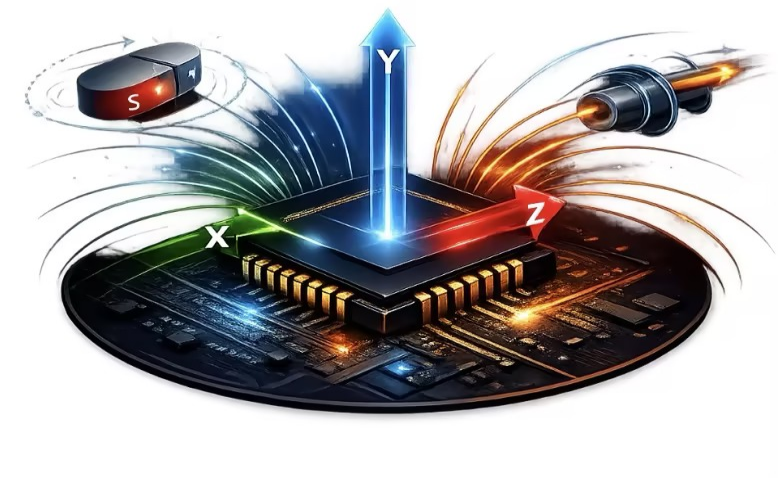
Demand for position sensing across industrial automation, automotive electronics and smart consumer devices has outgrown basic binary detection. Equipment features increasingly sophisticated motion patterns including rotational angle tracking, linear displacement measurement and 3D joystick manipulation, while stray magnetic fields originating from motor windings and high-current busbars prevail everywhere. Developed by Sichuang Microchip, the S4-3DB01 is a genuine 3D magnetic position sensing IC built on proprietary backside vertical Hall technology. It independently measures magnetic field components along the X, Y and Z axes simultaneously and executes full digital signal processing within a compact package.
I. Evolution Logic of Hall Sensing Technology
Conventional Hall sensors only measure magnetic fields perpendicular to the chip surface (Bz), whereas 2D Hall sensors capture Bx and By but fail to acquire Bz. True 3D Hall technology requires independent, low-crosstalk readout of all three field components. Featuring patented backside vertical Hall technology and a 3D layout of four Hall elements spaced merely 1 mm apart alongside a fully differential measurement architecture, the S4-3DB01 delivers high-precision triaxial field extraction with outstanding common-mode rejection against uniform stray magnetic fields. A single chip can therefore fully characterize arbitrary combined movements of a magnet in space, including rotation, linear translation, tilting and pressing.
II. In-depth Breakdown of Core S4-3DB01 Technologies
Differential Magnetic Field Measurement
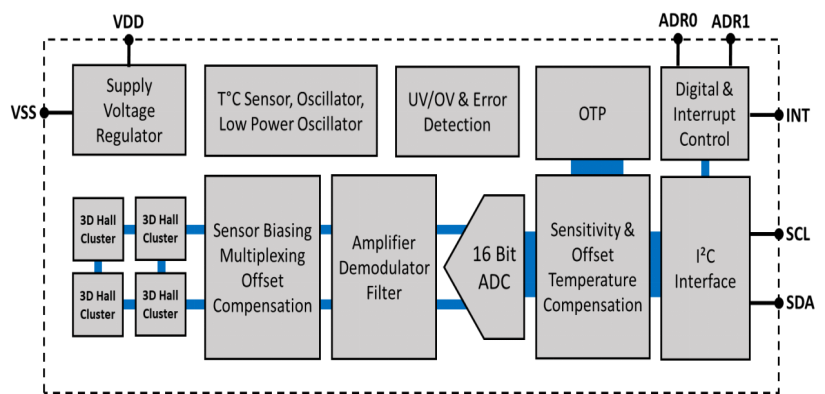
Four integrated Hall transducers (H1/H2/H3/H4) decouple Bx, By and Bz from raw input signals. This configuration delivers robust common-mode suppression of uniform stray fields stemming from leaking motor winding flux or magnetic coupling from adjacent actuators. The differential architecture largely cancels out homogeneous ambient magnetic interference while preserving the field gradient generated by the target magnet.
Specially engineered doping and vertical current design enable precise lateral magnetic field capture. Compared with traditional planar Hall sensors and Integrated Magnetic Concentrator (IMC) solutions, backside vertical Hall architecture eliminates hysteresis and saturation effects and achieves superior sensitivity to in-plane magnetic fields.
After low-noise amplification, temperature compensation and linearity calibration of raw sampled signals, users may configure sensitivity, conversion rate and power modes (continuous, low-power, wake-up) via the I²C communication interface. The IC directly outputs calculated angles, displacement vectors or raw ADC readings as required.
Housed in an 8-pin TSSOP package and certified per AEC-Q100 automotive qualification standards for an operating range of -40°C to 125°C, the device is well suited for high-temperature, high-reliability operating scenarios.
III. One Single Sensor for Three Major Motion Measurement Scenarios
For rotational angle detection: the IC computes absolute angular position spanning 0° to 360° from the proportional relationship between Bx and By field components. Concurrent Bz sampling further enables identification of magnet axial tilt or spacing variation.
For linear position detection: displacement is quantified by tracking the gradient of either Bz or Bx along the travel axis. Benefiting from differential measurement, the solution boasts exceptional robustness against mechanical tolerances, assembly deviations and thermal drift between magnet and sensor, maintaining excellent linearity on output signals.
For joystick applications: the S4-3DB01 demonstrates standout performance when mounted at a joystick’s base center. A magnet fitted on the joystick tip deflects freely across three dimensions, with the IC outputting real-time Bx, By and Bz readings. Simple vector arithmetic yields joystick tilt and azimuth angles, while continuous proportional output derived from Z-axis field strength variation delivers precise press-depth measurement.
IV. Integration-centric Design: Maximized System Design Flexibility
Thanks to complete triaxial vector output, exact alignment between magnet and chip along predefined axes is no longer mandatory. Magnets can be mounted flexibly with relaxed positional tolerances, and normal system operation is guaranteed as long as incoming magnetic flux stays within the sensor’s dynamic measurement range, drastically easing mechanical structure tolerance constraints.
The I²C interface supports multiple output formats and configurable slave addresses to facilitate multi-sensor coexistence on a single communication bus. Dedicated interrupt and dual address-selection pins simplify reliable system expansion.

V. Key Target Application Segments
Core implementations cover HMI components (rotary knobs, control levers, selector dials), door latch & exterior handle position detection, seat lock and seat travel measurement, window stroke limit sensing and HVAC air damper position monitoring.
Stray-field immune and maintenance-free sensing for non-safety critical robotic joint positioning, industrial actuator displacement, HMI selector knobs and industrial-grade SFI joysticks.
sparcsensor@ic-sparc.com
+86 13701993643
+49 (0) 871 660 665-0