

As data security and personal privacy protection regulations grow increasingly stringent, surveillance device deployment in office buildings and commercial complexes faces stricter compliance requirements. Operational issues such as unauthorized tailgating, idle meeting rooms and excessive energy waste persist, while staff and visitors hold growing concerns over facial recognition and high-definition footage recording. Striking a balance between security demands and privacy protection has become a core challenge in smart building construction.
Cisense Sensor Division presents the CS20-P ToF depth camera. Adopting time-of-flight technology, it captures 3D spatial contour data and delivers a biometric-free perception solution applicable to tailgating alert, passenger flow counting and space occupancy analysis.

Traditional access control systems focus on credential verification yet lack effective monitoring against close trailing passage. Mounted above turnstiles or door frames, the CS20-P outputs 30 frames of depth point cloud data per second to reconstruct real-time 3D passage contours. It distinguishes individual targets by analyzing size, height and motion trajectories, even when two people walk closely together.
Upon valid access authorization, the camera synchronously verifies the actual number of passing personnel. It instantly sends tailgating alerts once two or more targets are detected, triggering door halt or audio-visual reminders. Stable depth measurement performance backlights, dim and dark environments ensures round-the-clock reliable security perception.
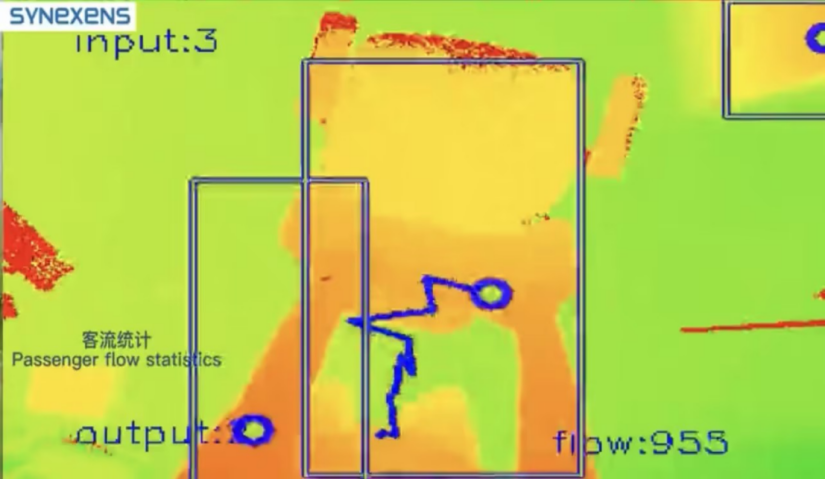
Facial capture cameras encounter rigorous legal restrictions in public areas under global data protection policies. Equipped with a 940nm VCSEL light source, the CS20-P only generates distance-based depth data without facial features, skin tone, clothing or other identity-related information, complying with the data minimization principle fundamentally.
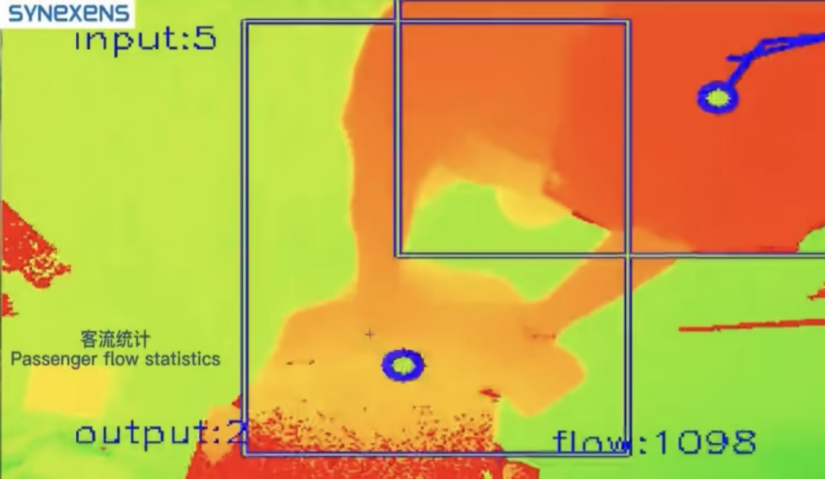
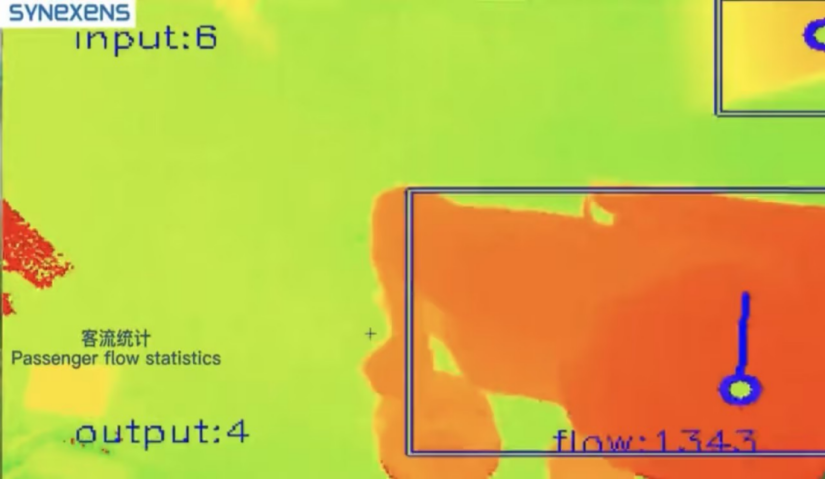
Installed at entrances and exits, it conducts bidirectional pedestrian counting by identifying moving directions. Ceiling-mounted installation enables real-time headcount within designated rectangular or fan-shaped zones. Virtual alarm zones help algorithms accurately separate humans from non-human objects, greatly cutting false alarms caused by trolleys and cleaning tools. It effectively simplifies privacy impact assessment for construction projects.
Common management dilemmas include fully booked yet vacant meeting rooms and underutilized workstations during peak hours. Lighting and air conditioning systems operate on fixed schedules, mismatching actual personnel distribution.
Supporting Ethernet networking, the camera can be deployed across ceilings of entire floors and buildings. Backend systems integrate multi-point depth data to generate personnel heat maps and temporal statistical reports.
Unoccupied reserved meeting rooms will be automatically marked idle after a set period. Hourly, daily and weekly occupancy statistics provide quantitative references for flexible workstation allocation. Combined with real-time crowd density, the system dynamically adjusts corridor lighting and fresh air volume to cut redundant energy consumption.
The camera adopts a 6-core aviation connector for integrated power and Ethernet transmission, featuring firm connection, vibration resistance and anti-loosening performance. Operating temperature ranges from -10℃ to 50℃ with average power consumption of 3.0W, lowering power supply and cabling costs. Its Class 1 invisible laser light ensures safe long-term operation in populated areas. The compatible Windows 10 SDK facilitates seamless integration with existing access controllers, building automation and cloud management platforms.

Refined smart building management requires perception devices to optimize performance while satisfying compliance rules. Featuring anonymous spatial data acquisition, the ToF depth camera serves as an ideal hardware choice balancing security alert, privacy preservation and space utilization efficiency. As building digitalization shifts from visual monitoring to precise perception, contour-oriented rather than identity-based sensing technology will gain extensive application prospects in diverse public spaces.
sparcsensor@ic-sparc.com
+86 13701993643
+49 (0) 871 660 665-0