

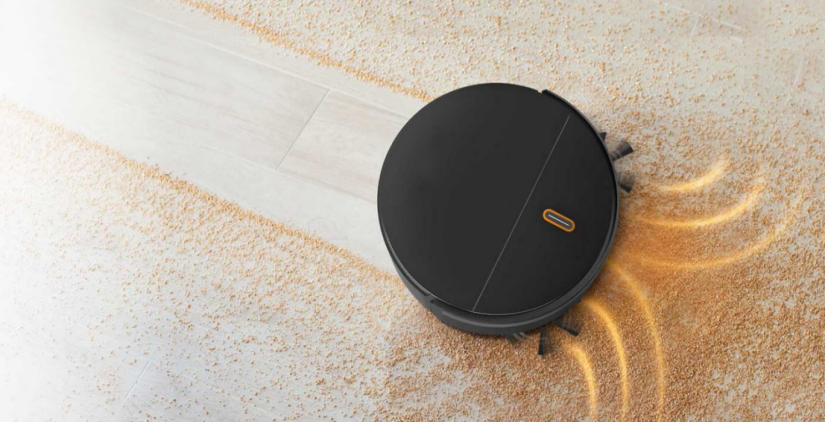
Common pain points plaguing robot vacuums include mapping deviation in large homes, ranging failure under intense light, difficulty identifying dark objects and missed edge cleaning. These issues stem from blind spots in the perception layer.
Cisense Sensor Division independently developed R5001 and M8001 dToF chips, delivering chip-level solutions for navigation and obstacle avoidance. This article analyzes how the chips help robot vacuums break through perception limitations based on practical application scenarios.
I. R5001: Long-range Navigation & Mapping
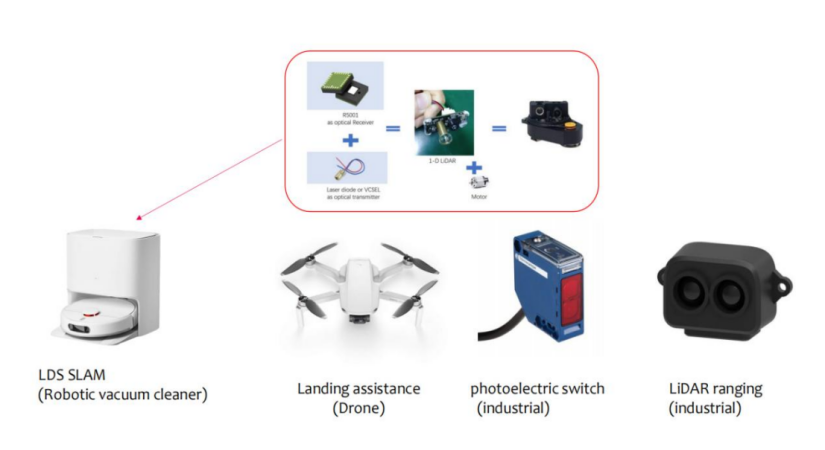
Conventional triangulation LiDAR suffers from short detection distance and weak signals in spacious living rooms and long corridors, resulting in distorted maps. The R5001 achieves a maximum detection range of 60 meters, enabling complete mapping for homes up to 200 square meters without repeated re-scanning.
Areas near balcony doors and floor windows are prone to operational malfunctions. Intense sunlight sharply reduces infrared signal signal-to-noise ratio, causing spinning or random collisions. Equipped with 905nm/940nm optical filters and built-in anti-sunlight algorithms, the chip operates steadily under illumination up to 100KLux. It adapts to direct indoor sunlight and even outdoor environments.
Superior precision guarantees authentic scene reconstruction. The R5001 maintains a ranging error within ±1.5cm across full measuring range with 1.2mm resolution. It accurately distinguishes carpet edges, threshold height differences and furniture outlines, laying a solid foundation for subsequent path planning.
Traditional infrared sensors are prone to misjudgment caused by varying ground reflectivity. Adopting direct ToF technology, M8001 stays unaffected by ground colors and materials, triggering timely emergency stops once stair edges are detected. Its integrated ROM design cuts startup time below 10ms, delivering faster response than mainstream alternatives without external MCU program loading.
Slender furniture legs, low slippers and light-absorbing dark carpets often evade conventional infrared detection. On-chip histogram algorithms eliminate crosstalk and implement dynamic stain compensation. Accurate ranging is ensured even with dusty sensor surfaces or low-reflection dark obstacles. Supported by 200Hz high frame rate, the robot executes delicate edge cleaning and flexible obstacle bypass.
Blind sensors lead to residual dust and uncleaned corners. Featuring compact 4.8mm×2.6mm×1.1mm packaging with integrated VCSEL transmitter and SPAD receiver, the sensor can be flexibly mounted on side and bottom chassis to eliminate dead zones, supporting wall tracking and upward detection against jamming risks.
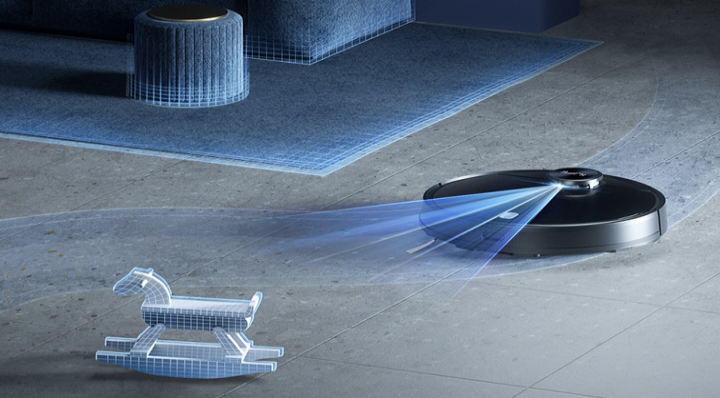
The dual-chip advancement marks not only technological breakthroughs but also Cisense’s steady progress toward systematic integration. R5001 extends navigation coverage and precision, while M8001 ensures safe and meticulous obstacle avoidance, empowering robots to fully perceive household surroundings.
Addressing actual user demands via technological innovation drives the industry evolution from basic intelligent cleaning to in-depth whole-house environmental perception. It represents Cisense’s technical strength and constitutes a vital contribution of Chinese intelligent manufacturing to the global smart home sector.
sparcsensor@ic-sparc.com
+86 13701993643
+49 (0) 871 660 665-0