

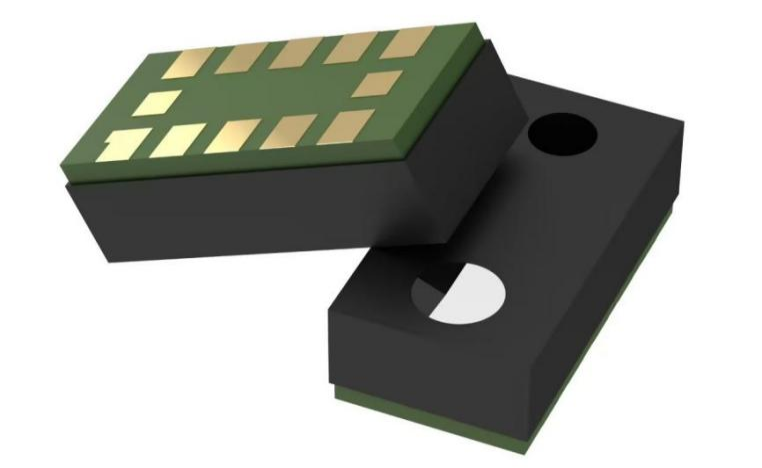
From drying to intelligent care, the focus of competition in the high-end hair dryer industry is quietly changing. The competition in product experience is no longer limited to motor speed or heating power, but increasingly extends to the machine's ability to perceive usage status. Behind this trend, the proximity sensor has become an important variable affecting the experience differences of flagship models. The M8001 dToF sensor launched by the Sensor Division of Xichan Microchip is tailor-made for intelligent care scenarios. The following disassembles the sensing solution of high-end hair dryer sensors from three dimensions: accuracy, frame rate and anti-interference.

I.Accuracy Determines the Safety Bottom Line
When a user blows hair close to the scalp, if the sensor falsely reports 10 cm as 12 cm, the main controller will maintain high-power output thinking the hair is still far away, and the risk of scalding will follow; conversely, if the distance is falsely judged to be too far when blowing hair from a distance, the main controller will reduce the power excessively, and the drying efficiency will drop off a cliff.
M8001achieves high-precision and stable distance measurement. This stability stems from the physical advantages of the dToF architecture: it directly measures the photon flight time through a Single-Photon Avalanche Diode (SPAD) to calculate the distance, and with the on-chip histogram algorithm, it caneffectively distinguish the real echo of hair from the stray reflections generated by the inner wall of the air duct and the structural cover plate, providing a solid data foundation for the main control algorithm.
II.Frame Rate Determines the Response Upper Limit
The moving speed of the hand during hair blowing can reach tens of centimeters per second. If the sensor frame rate is lower than 50Hz, the outputdistance data will always lag behind the actual movement, and the userwill feel that the air temperature is slow, or even fluctuates between cold and hot.
Frame rate determines the number of distance values output by the sensor per second.M8001 supports aframe rateof up to200Hz, allowing the main controller tofollow hand movementsin near real-time. For flagship models, the frame rate range of 100-200Hzis an importantwatershedfrom basic usability to comfortable and imperceptible experience.
III. Anti-interferenceDetermines Mass Production Yield
The bathroom is one of the unfriendlyenvironmentsfor optical sensors, with at least four challenges: water vapor, stray light, specular reflection and chemical erosion. M8001 has built multiple protections specifically from the beginning of design to ensure stable operation in real scenarios.
1.Reflectivity Difference Compensation
The built-in algorithm automaticallyadapts tothe differences between black hair's light absorption, light hair's reflectionanddry and wet hairconditions, andalwaysoutputs consistent distance measurement results.
2.Infrared Interference Filtering
Integrated with a dedicated infrared filter, it effectively shields ambient stray light such as vanity lightsand bathroom heaters, ensuringsignal purity.
3.Multiple Reflection Suppression
Forfalseechoes caused by multiple reflections that may be generated by structural components such as thetransparentcover of the air duct, theon-chip histogram algorithmaccuratelydistinguishes between true and falsefrom the time dimensionand eliminates interference signals.
4.Optical Window Erosion Compensation
The dynamic stain compensation functioncanautomatically offset thelong-termsignal attenuation caused by high-temperature steam and dust accumulation, maintaining measurement stability throughout the entire life cycle.
IV.System-level Advantages: Architecture Subtraction and Supply Chain Addition
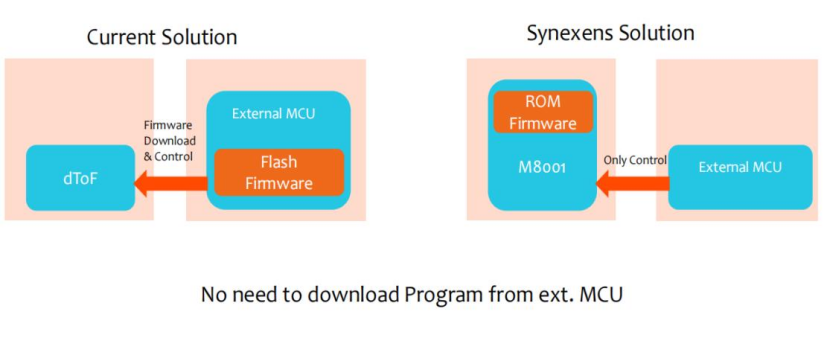
Most mainstream ToF solutions adopt external Flash for firmware storage and rely on an external MCU to download programs upon power-up. This leads to extra material costs, startup latency and EMC risks.
The M8001 features ROM-based firmware design, with programs pre-burned into the chip during production. No external Flash or MCU support is required.
It delivers three major advantages: startup time reduced to less than ten milliseconds for instant ranging; streamlined design cutting BOM costs and improving SMT yield; elimination of external high-speed bus radiation sources to lower EMC certification difficulties.
Backed by the group's IDM model, full vertical integration covers chip design, packaging and testing. Full independent control over core processes ensures stable supply flexibility and reliable delivery for clients.
V.Returning to Perception: The Starting Point of Intelligent Experience
The selection of ToF sensors for high-end hair dryers essentially trades certainty at the perception layer for greater fault tolerance at the execution layer.
Mandatory criteria include dependable accuracy, sufficient frame rate, strong resistance to bathroom environmental interference and proven mass production compatibility. Bonus system merits cover fast startup enabled by ROM architecture, optimized BOM costs, and robust supply capacity supported by the IDM model.
Amid industrial upgrading from basic drying to intelligent hair care, precise proximity sensing serves as the fundamental foundation of all smart experiences.
sparcsensor@ic-sparc.com
+86 13701993643
+49 (0) 871 660 665-0