

Recently, the State Administration for Market Regulation and 10 other departments jointly issued the "Guidelines for the Construction of Low-Flying Economy Standard System", clearly stating that by 2027, a standard system will be basically established, and by 2030, more than 300 standards and norms covering core links will be formed. The signal released by this policy indicates that the low-flying economy industry is moving from the early exploration stage into a standardized development cycle. The ability of drones to accurately determine altitude and reliably avoid obstacles in complex environments is becoming a prerequisite for large-scale applications.
一. Perception capability enters the realm of standardization
The standard system planned in the "Guidelines" directly links to the standardized requirements of perception technology in multiple key directions:
Infrastructure: The unmanned aircraft hangar system, intelligent communication and navigation need unified standards. Navigation relies on precise ranging, and the docking of the hangar requires close-range perception.
Safety supervision: Data link security, air traffic management standards, the reliability and anti-interference ability of perception data are the foundation.
Application scenarios: Agricultural spraying, urban logistics, power inspection, emergency rescue, each scenario has differentiated requirements for fixed altitude and obstacle avoidance.
The above indications show that perception capability has evolved from an additional factor for product competitiveness to an entry threshold for large-scale application.
二. Industry reality: Perception capability is the core support for large-scale application
Before the standard system was officially implemented, industry practice had accumulated rich scene experience. Complex working environments have higher performance requirements for perception systems:
Urban logistics delivery: When moving between buildings, strong reflection from glass curtain walls may cause saturation of ranging signals.
Agricultural ground flight: A centimeter-level height deviation may affect operational safety and effectiveness.
Power facility inspection: Fine cables and low-reflectivity targets pose challenges to detection algorithms.
These scenarios constitute the daily operational environment for low-altitude economic large-scale application. When the operation radius of unmanned aircraft extends from open fields to urban canyons and the operation time extends from daytime to nighttime, perception technology needs to continuously evolve to meet the requirements.
三. Technological breakthrough: The core requirements of perception chips for altitude determination and obstacle avoidance
To adapt to these complex scenarios, perception chips need to achieve breakthroughs in three key dimensions.
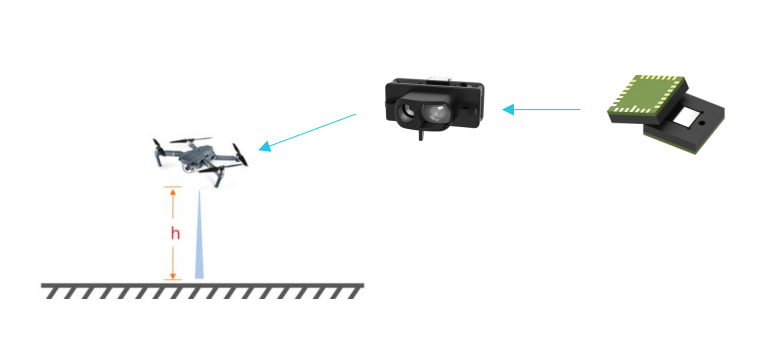
1. Precise altitude determination: Environmental adaptability determines measurement reliability.
Agricultural ground flight simulation, end-point landing in logistics delivery, and constant-altitude operations in mapping and inspection all rely on precise height information input. This places clear requirements on sensors:
The measurement range should be wide enough to cover both low-altitude landing and cruising heights.
Maintain stable output in strong light environments.
Maintain reliable echoes in low-light or low-reflectivity targets.
2. Intelligent Obstacle Avoidance: Material Independence and Dynamic Response Capability
Different scenarios such as urban logistics, power inspection, and forest fire prevention present differentiated challenges for obstacle avoidance capabilities. For instance, reflective glass facades, transparent obstacles, black cables, slender towers, foliage obstruction, and smoke interference. These pose clear requirements for sensors:
Target detection independent of material and color, capable of adapting to low contrast and transparent surfaces
Resistance to strong light interference, supporting the resolution of small targets (such as cables, towers)
Multi-echo processing capability to extract effective signals under smoke and foliage obstruction
High frame rate dynamic response to meet the requirements of rapid obstacle avoidance decisions
3. Fusion and Integration: From Discrete Components to System Solutions
A single sensor is insufficient to meet the requirements of all scenarios. The integration of multiple sensors has become the consensus direction in the industry. In the selection process, OEMs increasingly focus on:
Chip integration and complexity of peripheral circuits
Standardization of data interfaces
Supply chain stability and delivery guarantee capabilities
四. R5001 dToF Chip: Ranging and Perception Solution for Low-altitude Scenarios
The R5001 dToF ranging chip launched by Shengchuan Microelectronics Sensor Division has been specifically optimized for unmanned aerial vehicle altitude determination and obstacle avoidance scenarios. In complex lighting conditions and variable target environments, it provides stable distance perception data for aircraft, supporting altitude control and obstacle avoidance decision-making.

五. Industry Outlook: Technology Must Lead the Way for Standard Implementation
From the issuance of policies to their implementation in the industry, it relies on the coordinated advancement of all links in the industrial chain. For the field of sensing chips, the current focus includes:
Standard research and development: Conducting preliminary reserves on cutting-edge technologies to provide technical references for standard formulation
Dynamic iteration: Following the evolution of industry demands, updating product performance indicators and testing specifications
Open collaboration: Providing complete reference design schemes to help complete equipment manufacturers shorten the development cycle and time to market
The large-scale development of the low-altitude economy depends on whether each aircraft has the ability to reliably sense in real and complex environments. Policies define the operational boundaries, while technical design covers the airspace that can be reached.

sparcsensor@ic-sparc.com
+86 13701993643
+49 (0) 871 660 665-0