

AR/VR devices are accelerating their evolution towards wearable forms. Wearing detection, as the threshold for sensing user intentions, affects the wake-up response speed, false trigger rate, and overall battery life performance of the device. Traditional detection solutions need to simultaneously meet four requirements: fast response, low power consumption, small size, and high reliability. However, the external Flash architecture design makes it difficult to balance startup delay and system interference. The Sensor Division of Shengchu Microelectronics has launched the M8001 chip, which adopts its own ROM ToF architecture. It breaks through the above contradictions at the bottom level and provides a non-intrusive wake-up solution for AR/VR products. Currently, this chip has entered the mass production stage.

I. Technological Breakthrough: Three Transformations of the ROM ToF Architecture
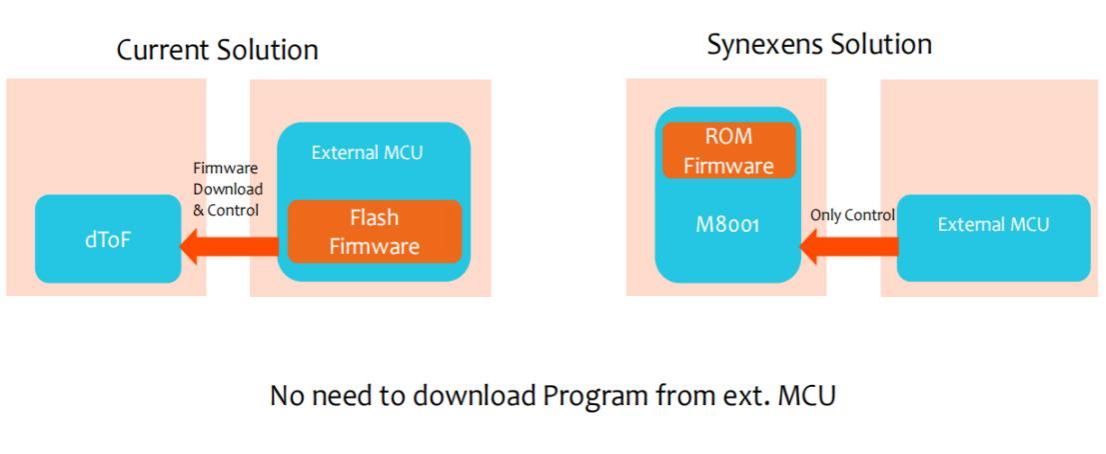
The M8001 integrates the firmware and core algorithms within the internal memory of the chip, eliminating the need for an external Flash. This enables the device to start running upon power-on, offering a differentiation advantage in terms of response speed, system stability, and integration.
1. Quick Startup within 10 milliseconds
The traditional external Flash solution requires a loading time of several hundred milliseconds during the startup phase, resulting in a noticeable screen illumination delay for users after wearing the device. The M8001 compresses the startup time from power-on to outputting valid distance data to within 10 milliseconds: at the moment the user completes the wearing action, the sensor has completed the ranging measurement and output the result, achieving an imperceptible wake-up.
2. Zero EMC Risk during Startup Phase
During the loading of the firmware in the external Flash solution, the high-speed communication of the SPI interface generates high-frequency electromagnetic radiation that may interfere with Wi-Fi, Bluetooth, and other antenna signals. The ROM design of the M8001 eliminates external bus activities during the startup process, eliminating the EMC risk at this stage from the source and being friendly to the wireless communication environment of wearable devices.
3. Reduced BOM Cost through Single-Chip Integration
The BOM eliminates the Flash chip and peripheral capacitor components. This not only directly reduces the material cost but also releases the PCB area previously occupied by the Flash, providing more space for the compact AR/VR glasses structure design.
II. Multi-scenario Roles: From Wearing State Detection to Lightweight Interaction
Based on the ROM ToF architecture, the M8001 can perform the following functions in AR/VR devices:
1. Wearing Status Detection
By using distance thresholds, it distinguishes between being worn on the head, handheld state, or placed on a table. Based on this, it triggers system wake-up or sleep, avoiding accidental triggering in pockets and protecting the overall battery life of the device.
2. Proximity Wake-Up
When the user's hand approaches the device, it detects changes in distance and quickly activates the menu or interface. Once the hand is removed, it automatically hides, achieving remote interaction.
3. System Energy Consumption Coordination
Upon recognizing the moment when the user removes the device, it notifies the SLAM and display subsystems to reduce frequency or enter sleep mode. This optimizes the overall system energy consumption at the system level.
4. Lightweight Gesture Triggering
It recognizes simple actions such as double-click confirmation and挥手 page flipping, providing developers with a low-latency and low-power auxiliary interaction channel.
III. Full-Chain Support: One-stop Delivery from Evaluation to Mass Production
The Sensor Division of Siyuan Microchip has established a comprehensive on-site support system covering the entire R&D cycle for the M8001:
1. Evaluation Phase
A complete evaluation kit including sensors, driver boards, and GUI software is provided, enabling the rapid completion of basic ranging function verification within a short period.
2. Integration Phase
Open hardware design guidelines (including PCB layout suggestions, optical window design points), register configuration instructions, and driver codes adapted to Linux/RTOS/bare-metal environments are made available.
3. Mass Production Phase
The chip has passed relevant industry standards certification and provides calibration algorithms that can be integrated into the production line, ensuring the consistency of each chip during mass production.

IV. Integrating Unconscious Interaction, Making Wearable Devices Understand Users Better
Every millisecond delay, every micro-ampere power consumption, and every square millimeter of board area can affect the competitiveness of AR/VR products. M8001 uses the ROM ToF architecture to compress the response speed of wearing detection below the perception threshold, enabling the perception task to be completed without the user's awareness, providing a perception option that balances response speed, system stability, and integration cost. Currently, M8001 has achieved mass production, and the evaluation kit and technical support have been made available to customers.
sparcsensor@ic-sparc.com
+86 13701993643
+49 (0) 871 660 665-0